The 60 Second Spelling Routine using Mapped Words®! Used across the Word Mapping Mastery® System to support self-teaching. "As much explicit instruction as needed. No more".


Word Mapping Mastery®: The Sixty Second Spelling Routine
The 60-Second Spelling Routine is used within Structured Linguistic Spelling (SLS) with Morpheme Mapping and by those using the Speech Sound Pics (SSP) Approach for self-paced Structured Linguistic Phonics (SLP).
SLS focuses on spelling and includes dedicated weekly instruction with Morpheme Mapping. The SSP Approach uses self-paced Structured Linguistic Phonics (SLP). The 60-Second Spelling Routine is shared by both, but isn't exclusive to either. It can be used alongside any approach or programme that supports bidirectional word mapping, helping learners strengthen the connections between a word’s phonemes, graphemes and meaning, supporting orthographic lexicon storage and developing their ability to learn and retain the spellings of unfamiliar words independently through self-teaching.
Parents and educators using the 60-Second Spelling Routine share an understanding that learners need access to the phoneme–grapheme correspondences in the words they're learning to read and spell, and that this knowledge can support independent word learning without relying on ongoing explicit instruction. We can't explicitly teach every word, so the words explored must help learners develop the skills needed to self-teach when they encounter new words.
This reflects the Word Mapping Mastery® principles underpinning Show the Code: Less explicit instruction, more self-paced learning.

We train parents and teachers to analyse and address spelling errors, and the 60 Second Spelling Routine is vital!


_edited.jpg)

From Explicit Instruction to Self-Teaching
Much of the research into spelling instruction asks an important question: how do we support children who are struggling?
We’re asking an earlier question:
How do we prevent those difficulties from becoming established in the first place?
Research into effective spelling instruction emphasises precise knowledge of the relationships between speech sounds and spellings, explicit teaching, encoding practice, analysis of spelling errors and repeated opportunities to strengthen orthographic knowledge.
The Speech Sound Pics (SSP) Approach applies those principles much earlier, but with a different goal: to reduce the amount of explicit instruction children ultimately need.
Teach children to map in both directions
Children learn from the beginning that the alphabetic code works in two directions:
Print → Speech when reading
Speech → Print when spelling
They’re taught to identify the graphemes in words and connect them with the speech sounds they use. When writing, they work in the opposite direction, identifying the speech sounds in the word they want to spell and considering the graphemes that represent them.
This makes their thinking visible.
If a child maps going and identifies an additional /w/, for example, the teacher can see far more than an incorrect answer. The mapping provides information about what the child is hearing, what they understand about the word and how they’re connecting speech with print.
That means support can be precise and immediate.
As much explicit instruction as they need, and no more
There is an inherent problem with delivering the same spelling instruction to a whole class at the same time.
Some children sitting through the lesson don’t yet have the knowledge needed to understand it.
Others already understand it and don’t need it.
Our aim is therefore not to keep children dependent on increasingly lengthy sequences of explicit instruction. It is to give them the knowledge and processes they need to become self-teachers as early as possible.
Children revise and bond speech, spelling and meaning as and when they need to.
When they need explicit support, they receive it. When they don’t, they move on.
As much explicit instruction as they need, and no more.
Technology supports independence, not dependence
Children cannot become independent self-teachers if they have to wait for an adult every time they encounter a word they cannot map.
Our bidirectional word-mapping technology enables children to check a word for themselves. They can access its spelling, speech sounds and mapping when they need it, use that information to resolve uncertainty, and continue.
The goal isn’t dependence on technology either.
The goal is for children to need it less and less as orthographic knowledge accumulates and self-teaching becomes increasingly efficient.
This is particularly important because emerging research into teacher word-mapping knowledge is raising questions about whether every adult supporting phonics has the knowledge needed to map unfamiliar words accurately. Children’s access to accurate information shouldn’t depend entirely on whether the adult beside them happens to know how a particular word maps.
Why spelling matters so much
A child may successfully read a word without having stored enough orthographic information to spell it accurately.
They may use known correspondences, context and Set for Variability to reach the correct spoken word. But successful decoding doesn’t necessarily mean that the precise sequence of speech sounds, graphemes and meaning has been sufficiently secured for later spelling.
Spelling exposes that precision.
A child who writes kickt may have represented the spoken word plausibly using the code they can currently retrieve. Rather than treating this simply as an error to correct, we can show the child kicked, map the word, and help them attend to and store the orthographic information they were missing.
This is why our emphasis on spelling is deliberate. We want children attending to the information that allows increasingly precise orthographic representations to develop.
Prevention changes the question
Much valuable research necessarily studies children who are already experiencing literacy difficulties and asks which forms of explicit instruction or intervention help them.
But there is another important source of evidence: classrooms in which practitioners are changing what happens before children struggle.
That action research can easily go unnoticed.
We’re interested in what happens when children are taught bidirectional mapping from the outset, teachers can see and respond to mapping errors as they occur, children have independent access to accurate word mappings, and explicit instruction is progressively replaced by successful self-teaching.
The question then changes from:
“How much explicit instruction do struggling children need?”
to:
“How early can we give children what they need to stop needing it?”
Emma Hartnell-Baker MEd SEN

Show the Code


English has an opaque orthography. For example, the grapheme <a> might represent one sound, as in ant and apple, but it represents at least eight other sounds in different words. Understand the Phonics Pronunciation Code (PPC). Show the Code™ Code. IPA Word Mapping Mastery® for all.
If children are to understand how speech and print connect, their teachers need to know too. Bidirectional Word Mapping Training should happen regardless of the phonics programme being used. Have you had any? We offer Word Mapping Formula training through ShowTheCode.com. We offer the training there as we also show teachers how to use MyWordz® technology to check the mapping of words themselves, and teach them about the IPA so they understand how and why Phonemies® are used as phonetic symbols for orthographic learners: anyone learning to read, spell and communicate in English. Training covers the 60 Second Spelling Routine.


Self-paced spelling is especially important because no programme can predict the orthographic knowledge of every child.
One child may know how to spell a word that another child has never explored. A child may know most of the correspondences within a word but have one specific gap. As children get older, the differences between their individual orthographic lexicons become wider.
Giving every child the same spelling list or asking every child to work through the same sequence does not address those individual gaps.
Instead, each child can have a personal Word Mapping Book. Whenever they need help with a word during reading, writing or learning across the curriculum, they record it in their book. They explore and store three connected elements:
-
the word’s speech sounds
-
its spelling, including the graphemes representing those sounds
-
its meaning
This makes orthographic learning responsive to the child’s needs in that moment. The words matter to the child because they have encountered them, wanted to use them or needed to understand them.
The 60-Second Spelling Routine
Recording a word is only the beginning. The child then uses the 60-Second Spelling Routine to secure its pronunciation, phoneme-grapheme mapping, spelling and meaning.
The aim is to store the word securely in the orthographic lexicon so that it can be recognised instantly when reading and retrieved accurately when spelling.
This gives teachers a manageable way to personalise spelling without creating a different programme for every child. The child’s own reading, writing and learning reveal the words that need attention. The teacher shows the mapping, and the child practises storing it.
Use MyWordz® word-mapping technology for any words they need to read or spell in the moment. This is important because the words they can’t yet read or spell will depend on the individual child and their existing orthographic knowledge. A predetermined curriculum cannot know what is already stored in that child’s orthographic lexicon, so it can involve a great deal of unnecessary instruction.
Use the 60-Second Spelling Routine to then bond the speech sounds, graphemes and meaning in the orthographic lexicon, supporting instant recognition in future reading and accurate spelling.
This aligns with Seidenberg’s position that there is such a thing as “over-teaching” and that the amount of instruction should be conditional on the child’s reading. He argues that if a child is already reading, recognising and understanding words, figuring out new words and understanding texts, “they can move on” (Seidenberg, 2023).
More recently, Seidenberg has described the goal as providing enough initial instruction for children to achieve “escape velocity”: reaching the point at which they can begin reading sentences and learning from a broader range of “reading, spelling, and writing activities”, rather than needing to learn every word through the same explicit instructional process (Seidenberg, 2026). Check our ShowtheCode.com to see the range of MyWordz.tech uses.
The principle is therefore to provide as much explicit instruction as the individual child needs, and no more, while giving them immediate support for the particular words they cannot yet read or spell. MyWordz® provides that support by showing the phonological–orthographic mapping of the word at the point of need, so the child can see the graphemes and their sound values for the word they actually need to read or spell. Follow this up with the 60 Second Spelling Routine.
References
Seidenberg, M. S. (2023). Responses to some of the chat from the May 23 Reading Meeting.
https://seidenbergreading.net/wp-content/uploads/2023/03/may-23-reading-meeting-chat-responses.pdf
Seidenberg, M. S. (2026). On Blending.
https://msseidenberg.substack.com/p/on-blending
Phonemies show the speech sound value of graphemes you don't yet know.
What is the Show the Code Approach to Word Mapping?
A free overview video for parents, teachers and anyone invested in ending illiteracy, promoting self-teaching and advancing social justice: ShowTheCode.com.
As seen within the Speech Sound Play Plan nost children learn all 48 Monster Sounds within around two weeks, thanks to brain plasticity.
A child with good phonemic awareness can learn to read and spell new words without the Phonemies®, as there is less cognitive load. They are already confident identifying the phonemes (speech sounds) and have usually developed good phonological working memory. Phonemies® are used as phonetic symbols and reduce cognitive load for children with weak phonemic awareness as they show the sound value of each grapheme.
This 4-year-old is blending 13 Phonemies® to say the word physiotherapist without using letters. Children using Speech Sound Play learn to isolate, blend and segment words into speech sounds using Phonemies® (Phonetic Symbols for Children).
They learn the 60 Second Spelling Routine as part of Speech Sound Play from around the age of three. It forms part of our Dys-Code® dyslexia risk screening and intervention approach before phonics.
Phonemies® help us to Show the Code™, enabling children to see which letters are graphemes and the speech sound each grapheme represents. If there is no indication of dyslexia risk, children can then use the 60 Second Spelling Routine without the Phonemies®. It typically takes around one to three run-throughs with the mapped word for them to store the speech sounds (phonemes), spellings (graphemes) and meaning, leading to instant word recognition when reading and accurate spelling when writing.
A child with weaker phonemic awareness may need three to seven run-throughs. Importantly, the process itself strengthens phonemic awareness, so the more children use the 60 Second Spelling Routine, the easier it becomes for them to isolate, segment and blend speech sounds, both with and without graphemes.
Children should first learn the 60 Second Spelling Routine using familiar words so that the process becomes automatic. Within the Speech Sound Play plan they begin by building simple words such as sat, pin and tap. Once the routine is secure, it can be used with every new word. Initially, the mapped word is available to support learning and is then removed so that the child can demonstrate mastery.


Phonemies® are a complete set of Phonetic Symbols for Children. When learning new words, they can see which letters are graphemes and their sound value.
This Show the Code system (powered by Ortho-GraphiX®) maps ALL words of English.
Phonemies® can be switched to reflect accent variation.
Phonemies® - Speech Sound Monsters® - are child-friendly representations of speech sounds, without letters. This image shows the Speech Sound Monster that says /əʊ/


Over ten years ago, when supporting schools in Australia, I realised that children might know the word but often weren't seeing exactly which letters are the graphemes, so I created Code Mapping®.
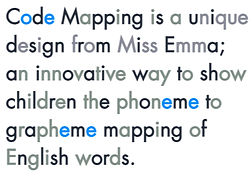
Code Mapping® uses black and grey throughout the whole text, with blue to denote a split digraph. Every word is segmented into graphemes, and each grapheme is shown as a complete unit across the word. Alternating colours are not decoration; they simply mark the boundaries between graphemes so the structure of every word can be seen at a glance.
I then wanted a way to show the sound value of each grapheme, because seeing which letters graphemes are often wasn't enough. For example, the letter <a> can represent at least nine different speech sounds when reading (print to speech), while a single speech sound, such as /e/, can be represented by at least nine different graphemes when spelling (speech to print). Many children with SEN found these relationships difficult to understand.
I wanted to make those connections visible, so I developed Phonemies®: child-friendly symbols representing every phoneme in English.
Together with the Ortho-GraphiX® algorithm, this made it possible to map the complete English alphabetic code for any word, showing both which letters are graphemes (Code Mapping®) and the sound value of those graphemes (Monster Mapping®).
An unexpected benefit was that Phonemies® also solved a completely different problem. Children no longer needed speech or letters to demonstrate which speech sounds they could hear, used in their accent, or wanted to use when spelling. A non-speaking child could simply select the relevant Phonemies®, or arrange them to build a word from its speech sounds.
That capability became the foundation of Speech Sound Play®, and is the same underlying methodology being digitised through Dys-Code®. During dyslexia risk screening, children demonstrate speech sound processing using Phonemies®, without requiring spoken responses, letter knowledge or English vocabulary.
Let's Show the Code when supporting word mapping.
Miss Emma
Emma Hartnell-Baker MEd aka The Code Mapping Nerd


From explicit phonics instruction to self-teaching
The purpose of phonics instruction is not to explicitly teach every word a learner will ever encounter or every grapheme-to-phoneme correspondence. The purpose of explicitly and systematically teaching the Core Code, around 100 of the most commonly used grapheme-to-phoneme correspondences, is to kick-start self-teaching.
The SSP chant strip below shows the order in which we teach the Core Code in Reception. It is the only self-paced phonics programme designed for the classroom. Technology delivers this constrained skill, freeing teachers to observe, assess and provide support exactly where and when it is needed.
Once learners have mastered the Core Code and understand word mapping, they don't need explicit phonics instruction for every new word they encounter. They need the pronunciation and meaning of the new word. They should then be able to map the spelling to the pronunciation through self-teaching because they have been taught to map words bidirectionally.
In reading, pupils are taught to decode by identifying graphemes in written words from left to right, saying the corresponding phonemes, and blending those phonemes to say the whole word (Department for Education, 2023, p. 47).
In spelling, pupils are taught to say a word clearly, segment it into phonemes, and select graphemes to represent each phoneme in writing (Department for Education, Writing Framework, 2025, p. 41). Statutory spelling guidance further states that teachers should draw pupils' attention to grapheme-to-phoneme correspondences that both do and do not fit with what has been taught so far (Department for Education, Spelling Framework, p. 75).
The DfE therefore expects teachers to apply word mapping to all words, across all year groups, so that learners continue acquiring grapheme-to-phoneme correspondences beyond those explicitly taught within their phonics programme. There is a clear gap between the Core Code taught by phonics programmes and the alphabetic code needed to read and spell English fluently. To learn the whole alphabetic code, learners must transition into the self-teaching phase.
If they can't, that's a word mapping issue, not a reason to provide more explicit phonics instruction.
That's why we use MyWordz® word mapping technology, powered by Ortho-GraphiX®. It shows which letters are the graphemes and their sound value at the point of need and can map and voice any English word. Learners use the technology to support the mapping process whenever they need it.
Once a new word has been mapped, learners use the 60 Second Spelling Routine to bond it into the orthographic lexicon. As their orthographic knowledge grows, they become increasingly independent, able to work out unfamiliar words even when there isn't an adult there to tell them the pronunciation.
As much explicit instruction as they need. No more.


Interested in piloting Spelling Simplified activites? Try the MyWordz® with MySpeekie® technology in your Reception classroom for 12 months, from September 2026 (England) or January 2027 (Australia), with free web and tablet access to the platform and online support throughout the pilot.
Spontaneous: When children have written a word that is not spelt right, or they want to check it before trying it, type the sounds on the Phonetic Keyboard, with Phonemies® as Phonetic Symbols for Kids, to see the spelling and hear it voiced if useful. They can then use Check Mapping. Simply say the word to see the graphemes and their corresponding sounds. This is guided self-teaching that soon needs no guidance, as the child can teach themselves the orthographic knowledge they need using the technology. Secure with the 60 Second Spelling Routine.
Planned: Spell-O Sentences. See https://www.speechsoundpics.com/spello
They then do the 60 Second Spelling Routine to store the word in the orthographic lexicon for instant recognition in future and accurate spelling when writing.
This is the future of "only as much explicit instruction as needed. No more." It is Spelling Simplified. Register at Speech Sound Pics (SSP)

Spelling Simplified: Show the Code
Interlinked Word Mapping Mastery® Learning Pathways: Easier, Speedier Reading and Spelling for All Neurotypes.


Phonics Reform England (PRE) offers school training and support in creating Individual Support Plans for the 1 in 5 children at risk of, or already struggling with, word mapping. The Department for Education states that, in spelling, pupils should be taught to say a word clearly, segment it into phonemes, and select graphemes to represent each phoneme in writing (Department for Education, Writing Framework, 2025, p. 41). Sign up for on-demand IPA Word Mapping Mastery® training to learn how to understand the Phonics Pronunciation Code (PPC) for decoding encoding and use ECO (the English Code Overlay).

The Speedie Sight Word Project
IPA Word Mappping Mastery: Storing Words in the Brain's Word Bank


Many parents still think that “sight words” have to be memorised. On this site sight words are taught through word mapping, so every word can be understood, read, and spelled by linking sounds to letters. Word mapping makes the structure of each word visible. Instead of guessing or memorising, children learn how spoken words connect to written words. This supports confident reading and accurate spelling from the very start. Children Show the mapped word during learning, but remove it when children are demonstrating mastery.
A child with good phonemic awareness will figure out the mapping even if not shown the code, but let's not take any risks.
Skilled readers navigate the whole code. They can read The Chaos and make sense of the complexity of English orthography.


Children with strong phonemic awareness easily connect speech sounds, spelling, and meaning when shown mapped words that make clear which letters form graphemes and their sound value. This is why we recommend the Speech Sound Play Plan before starting phonics. This bonding supports storage in the brain’s word bank, the orthographic lexicon, enabling instant recognition in future and accurate spelling. Around 1 in 5 children will require more repeated exposure to achieve this, which is where The Spelling Routine provides the structured practice needed to secure these mappings. Add this to Individual Support Plans, when there is a risk of dyslexia.
No Rules Allowed

Screenshot shared for critique and discussion. This kind of rule-based instruction is exactly what many dyslexic children experience as overwhelming and misleading. This post is about the impact, not the creator.
This is the nightmare.
Rules that aren’t rules.
Exceptions stacked on exceptions.
Dyslexic children don’t need more tricks.
They need clarity.
No rules allowed.
Chunking also adds extra cognitive load without supporting accurate mapping
Do you have a dyslexic child who’s struggling with spelling lists, and you aren’t sure how to help?
Spelling words often don’t stick, no matter how much practice they do, and it can feel like guessing, memorising, or starting again every week.
Use the free 'Lite' version of the Code Mapping Tool to type the words and generate Mapped Words® that shows which letters are graphemes.
Then, using that mapped word, use the simple 60-second Spelling Routine that helps the spelling stick long-term instead of being relearned each week.
The world’s first Code Overlay system that makes graphemes and their sound values visible directly on written text for every word in English. The structure of words is shown, designed by SpLD experts to support dyslexic brains.
WE SHOW CHILDREN WHICH LETTERS ARE GRAPHEMES AND THEIR SOUND VALUE WITH PHONEMIES
The Spelling Routine with Mapped Words® supports orthographic mapping for all neuro-types.
"Less Teaching, More Self-Teaching"
Emma Hartnell-Baker MEd SEN | Doctoral Researcher | Innovate UK Winner | Creator of MyWordz® with MySpeekie® | Word Mapping Mastery® technology with Phonemies® and the world’s first one-screen AAC | Show the Code with Mapped Words®


Have a free play of the world's first word mapping technology that shows which letters are graphemes for any word of English. https://www.speediereadies.com/orthographic-mapping-tool


Storing Words in the Brain’s Word Bank Is Easier with Mapped Words®. Struggling students can instantly see graphemes and their sound value, with no memorising whole words. Spelling with no guessing and no stressing. We create resources and activities to help dyslexic children read and spell more easily.
If they don't know it, show it!
We also use IPA aligned Speech Sound Monsters, called Phonemies. "Follow the Monster Sounds to Say the Word"
The Spelling Routine with Mapped Words® gives learners exactly what the science tells us is needed to map speech to print and store words in the brain’s word bank, the orthographic lexicon, in less than two minutes. It supports Word Mapping Mastery® by enabling self-teaching, which is the bridge between explicit phonics instruction and orthographic mapping.
Mapped Words®: Show the Code. The Brain Self-Teaches More Easily Between Birth & Age 7.


Show the Sight Word Code with Mapped Words® Neuroscience shows your child’s brain learns through understanding, not memorisation. We make the Word Code visible so the brain can learn it for itself. Mapped Words® also help EALD, ESL, and EL children pronounce high-frequency English words accurately. Mapped Words® offers all brains the quickest, easiest way to store words and then recognise them instantly when reading, including words some call 'tricky' or 'irregular', and spell them correctly when writing, independently, at any age or stage. All words become sight words when we show the sight word code and use the Spelling Routine. Speech sounds, spelling, and meaning are bonded without memorisation, strengthening phonemic awareness and phonological working memory, preventing the dyslexia paradox. No more guessing or memorisation. Parents and tutors learn to support early, easy Word Mapping Mastery® from birth. with support from Emma Hartnell-Baker aka The Word Mapper, at SpeedieReadies.com
The words in this list are in order of their frequency of use in everyday writing. As the is the most frequently used word in the English language, it appears first in the list. According to The Reading Teacher’s Book of Lists, the first 25 words account for approximately 33% of everyday writing, the first 100 words appear in around 50% of adult and student writing, and the first 1,000 words are used in approximately 89% of everyday written text. All of these words are included in the MyWordz® technology word bank. As a result, children can use MyWordz® to work out the structure and pronunciation of almost all of the words they are likely to encounter in the texts they need to read and the words they need to write. These HFWs are also explored within the series of 100 Village With Three Corners books from the One, Two, Three and Away! series used within Speedie Readies. Emma Hartnell-Baker argues that children find it easier to learn to read when they are motivated by interest in the books they are reading, and that this provides a quicker route to self-teaching.
Mapped Words®: Show the Sight Word Code
the
For previous Mapped Words® use the Search function or suggest new ones by emailing Mastery@MappedWords.com
Spelling

Meaning
Speech Sounds (Phonemes)


How can children spell words using graphemes you haven’t taught in phonics lessons?
They type the sounds.
They check the spelling.
Then you ask:
“What’s new for you?”
That question is gold.
It switches on their pattern-seeking, prediction machines.
It invites the brain to notice new information.
The first sound in in is the same sound represented by a in sausage and a in orange.
For children only learning The Core Code, that spelling is unexpected.
And unexpected patterns are powerful.
The brain updates.
Refines its prediction.
Stores the word.
They don’t guess.
They don’t memorise.
They discover.
And they can check independently while they’re writing.
No waiting.
No supervision.
No-one hovering.
Feed the spelling brain patterns, not rules.


Use the MyWordz® technology to check the letters (graphemes) and sounds (phonemes) for that word, and then use The Spelling Routine to store it in the brain’s word bank (orthographic lexicon). With good phonemic awareness the word is stored after only one run through.
Word Mapping Mastery®Technology
Monster Spelling Piano (MSP) app for tablets
The Spelling Routine
The Spelling Routine is used in Reception, when children can draw lines, numbers and letters, but also offers a cost-effective and highly impactful KS2 spelling system for dyslexic students. Use it with or without Phonemies (Speech Sound Monsters®). Show the Word Code. Word Mapping Mastery® for all neuro-types.
No more memorising whole words. No more learning parts of words by heart.
Words are learned when speech sounds, spelling, and meaning are bonded together.
Learn to use The Spelling Routine so that words are stored in the brain’s word bank. Learn to support self-teaching from birth https://www.SpeedieReadies.com/parent-tutor-course
Help us build the world’s largest mapped word bank, so anyone, anywhere can see orthographic mapping in real time for every word. No more heart words.


This is different from anything else because MyWordz® technology shows the word already mapped. We show speech sounds with Phonemies and call graphemes 'pictures of speech sounds' ie Speech Sound Pics®! We show the sight words orthographically mapped.
Speech sounds (phonemes), spelling (Sound Pics®), and meaning are made visible together, and the learner completes a short spelling routine to store the word in the orthographic lexicon. Nothing is guessed. Nothing is memorised. Nothing depends on whether the graphemes have been “taught yet”. Phonemic awareness and phonological working memory is strengthened. This is crucial for dyslexic learners.
Phonics programmes try to get learners to infer this structure over time. Some ask chilren to learn words with graphemes they don't cover as 'tricky' and ask children to learn those graphemes by 'heart'. Whole language skips word mapping entirely.
This makes the structure explicit, in the moment, for any word. Any time.
That shift, from instruction to visibility, is what changes outcomes. Emma Hartnell-Baker has shifted the focus away from often ill-informed instruction and towards making the code visible so the brain can learn it for itself. Miss Emma is also known as The Word Mapper!


I realised it was time to stop fighting the existing reality and build something new. Something that brains could use to teach themselves, in the same way children learn spoken language, and in the way some children have managed to learn to read for decades without instruction, regardless of the latest fad or supposed evidence.
To stop adults asking children to memorise whole words, or to learn parts of words “by heart”, the same approach repackaged to sound more palatable to phonics advocates but still missing the mark, I needed to show the code. A code already shown universally, in part, through the IPA.
In 2012, Code Mapping® was developed as an Orthographic Mapping Tool, using black and grey coding, with blue to highlight split digraphs, referred to as Sound Pic® Sandwiches. This made the graphemes visible. It was used within classrooms using the Speech Sound Pics (SSP) Approach. In those reception classrooms teachers do not teach phonics, children learn the Code Code using my tech and resources at their own pace with teachers freed up to montor the learning of children as individuals.
In 2014, I added the missing piece by making the phonemes visible, through Speech Sound Monsters®, now also known as the Phonemies® Family. I called it Monster Mapping® initially. When I returned to England I saw a phonics programme using 'Monsters' and needed to distance myself from that.
By showing both the graphemes and the phonemes, alongside meaning, the full code becomes visible. When children can see the speech sounds, the spelling, and the meaning together, and especially if they use my Spelling Routine, those elements bond in memory and are stored in the brain’s word bank. This approach bypasses ill-informed instruction and moves learners directly into self-teaching at speed.
That is Speedie Word Mapping, and it is the driver of Word Mapping Mastery®.


Parents need to understand what children’s brains require in order to store words, and to integrate this into daily life from birth, alongside talking, singing, and reading stories.
For children whose brains are already wired to find reading and spelling easy, parents strengthen connection and confidence through shared language and stories. These are the children who are later often described as having “taught themselves to read”. I want parents to understand how that actually happened, so this knowledge is no longer mysterious or reserved for a lucky few.
For the one in four children who will never read or spell at a level required to learn successfully in school without the right support, parents become their first and most important dyslexia coaches from birth. By understanding what their child’s brain needs, parents can help them avoid the damaging “wait to fail” that is still built into the system, often with no guarantee that any later intervention will truly work for them. This is why parents are one of the most powerful forces we have in preventing the current so-called SEN crisis. I share this knowledge through training sessions for members, while continuing to make many Speech Sound Play and Speech Sound Pics Approach resources freely available for those who need them.

Our Dyslexia Tutors Don’t Teach Just Phonics.
They SHOW Phonics. Speedie Phonics!
Less Teaching. More Self-Teaching.


Speedie Orthographic Mapping: The Brain Self-Teaches More Easily Between Birth and Age 7.
Order the Monster Spelling Mat and other resources to support word mapping at SpeedieReadies.com


The primary domain for this site is TheSpellingRoutine.com. This site focuses on The Spelling Routine using Mapped Words®, part of Word Mapping Mastery®. The domain was updated from MappedWords.com for clarity. The Spelling Routine supports whole class instruction through the Speech Sound Pics (SSP) Approach, and 1:1 learner support through Speedie Readies.

